The Scottish Symbols: Integral Part of Scot's Identity
Continuing Relevance of the Iconic Scottish Symbols
Here are some of the most iconic Scottish symbols that have stood the test of time and continue to hold significant meaning in Scotland.
The Saltire:
The Scottish Saltire, representing the cross of Saint Andrew, Scotland’s patron saint, dates back to his crucifixion on an X-shaped cross in the 1st century AD. Legend states that during a battle in 832 AD, King Óengus II saw the saltire in the sky after praying for victory, leading to a Scottish win and St. Andrew being declared the patron saint.
The Saltire Flag appeared on Scottish soldiers’ tunics in the 14th century, and the first printed image of a St. Andrew’s cross flag appeared in 1503. By 1542, it was shown with a blue field. During the Jacobite Uprising of 1745-46, rebels wore bluebonnets with A Wearable Saltire.
Today, the Saltire remains a widely recognized symbol of Scotland, appearing on everything from Kilt Pins to Belt Buckles, from street signs, and is also used in contemporary art and design, such as in the work of Scottish artist Peter Doig. also they had Sporrans made out with the Saltire Style.
The Scottish Thistle:
The Thistle, an enduring emblem of Scotland, has roots tracing back to the 13th century under Alexander III. It first appeared on silver coins minted by James III in 1470 and today symbolizes Scotland’s esteemed Order of the Thistle.
Featured in the Royal Coat of Arms, the thistle also inspired the motto, “Nemo me impune lacessit” (“No one harms me with impunity”). Legend links the thistle to the 1263 Battle of Largs, highlighting its association with Scottish resilience and defiance against oppression.
The Lion Rampant of Scotland:
The Rampant Lion, a cherished symbol, features prominently on the Royal Banner of Scotland, known as Bratach rìoghail na h-Alba in Gaelic and Ryal banner o Scotland in Scots. This golden flag is officially reserved for the King of Scots and Great Officers of State, representing the Sovereign. The banner depicts a red lion with blue tongue and claws on a gold background, surrounded by a floral border.
Used since King William I’s reign, the Lion Rampant has symbolized Scotland for centuries. King Alexander II adopted it around 1222, with Alexander III adding the floral border. Since James VI became the English and Irish monarch in 1603, the Heraldic Lion has represented Scotland in British royal arms and banners.
The Unicorn:
The unicorn is a key symbol in Scottish culture, first appearing on King Kenneth MacAlpin’s coat of arms and later used by King William I to represent strength, purity, freedom, and protection. In folklore, it is a mystical creature with healing powers. As Scotland’s national animal, it has been on the royal coat of arms since the 15th century.
Unicorn statues at the Scottish Parliament, commissioned by Queen Elizabeth II in 1999, symbolize unity and independence. Today, the unicorn remains a celebrated emblem in Scottish culture, featured in events like the Highland Games.
The Honours of Scotland:
The Honours of Scotland, also known as the Scottish Crown Jewels, are a collection of royal regalia that include the crown, sceptre, and sword of state. The Honours of Scotland are the oldest surviving set of crown jewels in Europe and have been used in Scottish coronations since the 15th century.
The Honours of Scotland were hidden away during the English Civil War and were not rediscovered until 1818. They are now on display in Edinburgh Castle, where they can be seen by the public.
The National Tartan of Scotland:
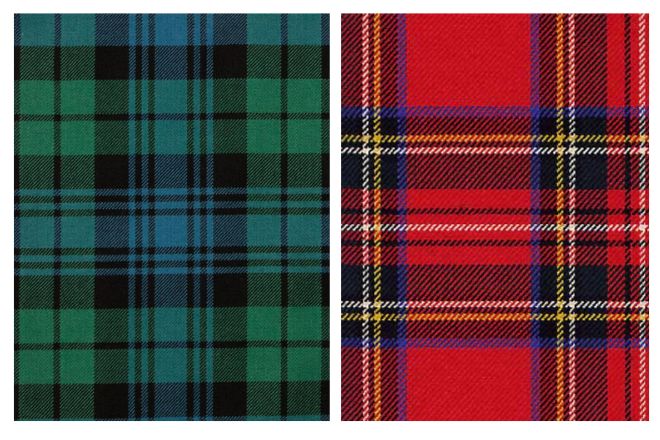
Tartan, a textile pattern of intersecting stripes, originated in medieval Scotland and became a cultural symbol, representing clans and regions. The Scottish Register of Tartans records all patterns, highlighting their historical significance. Beyond tradition, tartan is a global fashion statement seen in Tartan Kilts, Tartan Skirts, and Kilt Accessories, and features in modern fashion, interior design, and commercial products like whisky bottles and souvenirs. Its rich history and versatility make tartan an enduring symbol of Scottish heritage.
Frequently Asked Questions
What are Scotland's national symbols?
The Saltire, or St Andrew’s Cross, is the national flag, a white diagonal cross on blue, and one of the oldest national flags still in use. The thistle is the national flower, the unicorn the national animal, and the Lion Rampant the royal standard. The Honours of Scotland, the crown, sceptre and sword, are the oldest crown jewels in Britain.
Why is the thistle Scotland's emblem?
The traditional story is that a barefoot Norse raider trod on one while attempting a night attack and his cry gave the Scots warning. There is no contemporary evidence for the episode, and the thistle appears on Scottish coinage from the fifteenth century without explanation. It endures because the symbolism fits: hardy, defensive and difficult to handle.
Why is Scotland's national animal a unicorn?
The unicorn was a medieval symbol of purity and untameable strength, and it entered the Scottish royal arms in the fifteenth century. It is shown chained, which is generally read as a powerful beast that only a king could master. It has faced the English lion on the united royal arms since 1603.
Can anyone fly the Lion Rampant flag?
Strictly, no. The Lion Rampant is the Royal Standard of Scotland, reserved for the monarch and a small number of royal officers, and unauthorised use is an offence dating to a 1672 Act enforced by the Lord Lyon. In practice it is flown widely at sporting events and is not prosecuted. For general use the Saltire is the correct national flag.
What is Scotland's national tartan?
There is no single official one. Royal Stewart is commonly treated as a national sett despite formally belonging to the sovereign, and the Scottish National tartan, Flower of Scotland and Pride of Scotland are all worn by people with no clan claim. Any of these is an appropriate choice where no family tartan applies.
Explore products
Browse all products →
A professional writer known for producing authentic, research-based content on Irish and Scottish heritage.