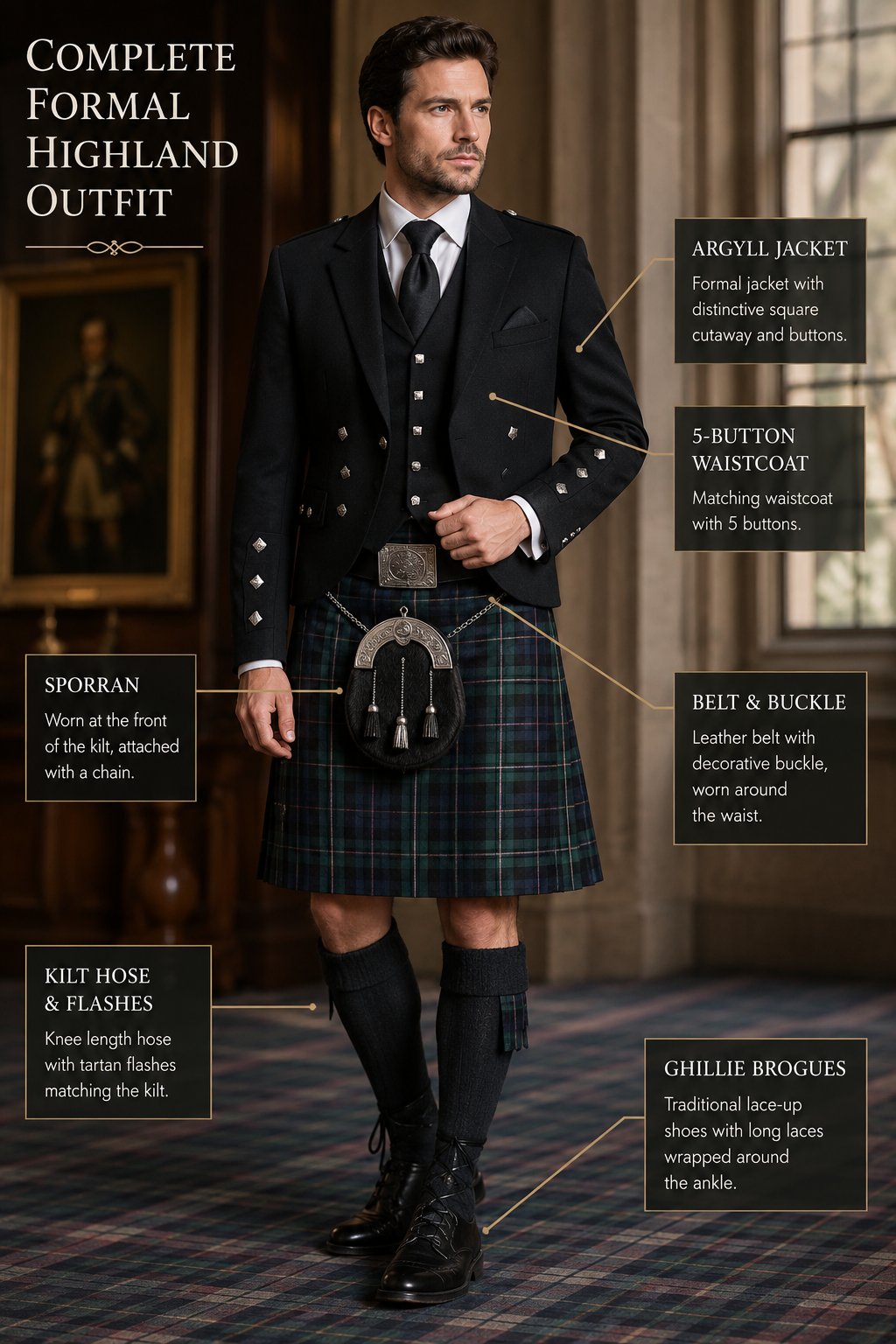
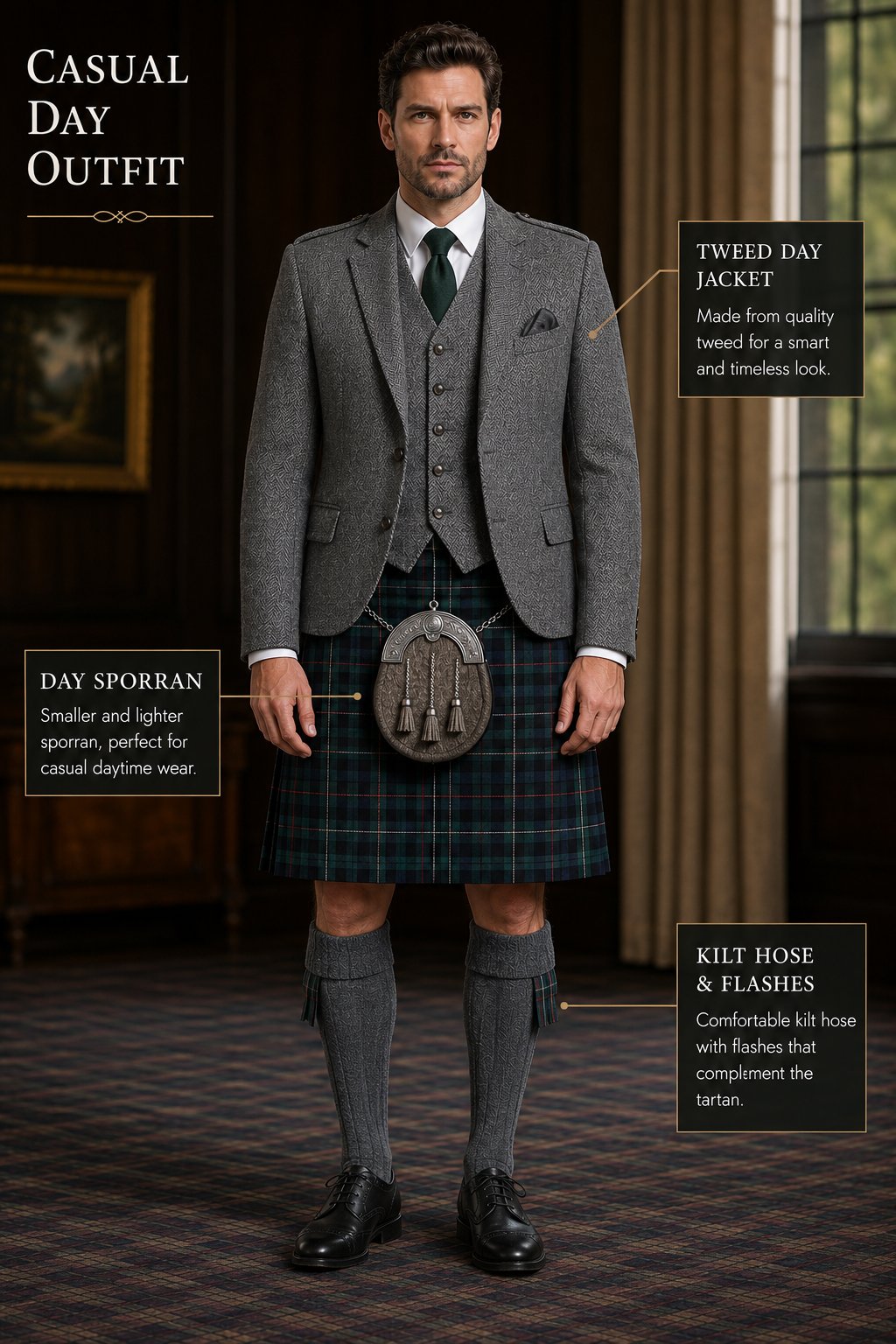
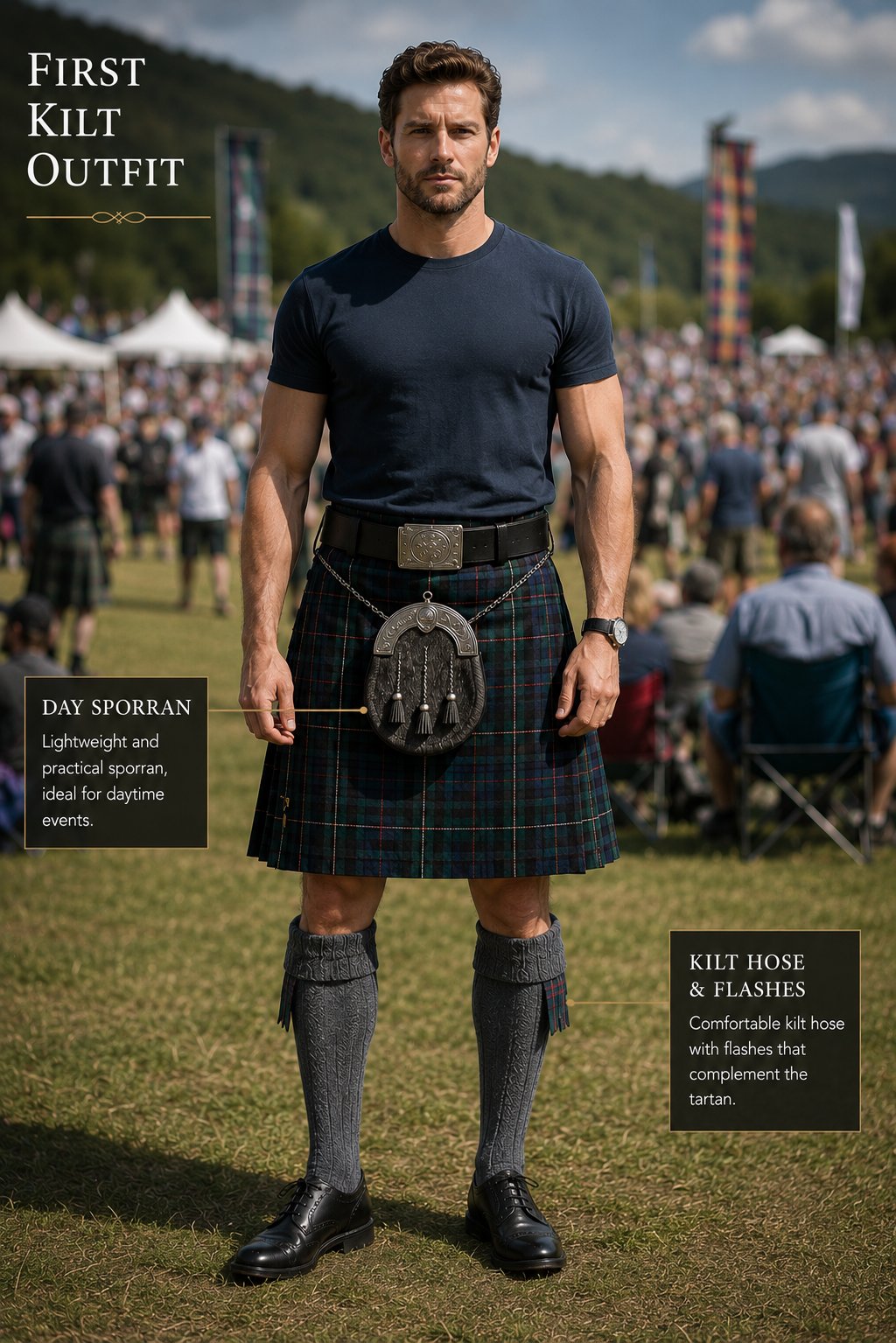
This is everything Abercrombie tartan: from a full Highland outfit to a single scarf or a length of cloth, woven in the Abercrombie sett and dispatched worldwide.
ii.
Colourway Options for Abercrombie Tartan
Pick the shade that suits you: Modern (rich, bold colour), Ancient (soft, lighter tones), Weathered (faded, natural look) or Dress (brighter, formal). The selector is on every product.
iii.
Abercrombie Tartan Accessories for Every Outfit
Complete the look or treat someone with Abercrombie tartan accessories — scarves, ties, sashes, flashes and ribbon are all available.
iv.
Made to Order, Shipped Worldwide
We ship Abercrombie tartan orders worldwide with tracked options at checkout. Custom sizes and group orders are welcome — just ask if you need advice.
v.
Abercrombie Tartan Fabric for Makers
Need cloth rather than a finished item? Abercrombie tartan fabric is sold by the metre for kilts, sashes, furnishings and craft work, with samples available on request.
vi.
Abercrombie Tartan Kilts & Outfit Packages
Choose a Abercrombie kilt on its own or as part of a full outfit. Made-to-measure sizing means a clean fit for grooms, guests, dancers and pipers alike.

Clan Motto
Petit Alta (He seeks high deeds)
Heritage & Identity
Who Wears Abercrombie Tartan Tartan?
Worn by Abercrombie descendants worldwide, sept families including MacCrombie and Crombie bearers, Highland regiment members, and Scottish heritage enthusiasts across America, Canada, and Britain.
Associated Names
MacCrombie
Crombie
Cromb
Crombe
MacCrumb
Crumbie
Abircrumby
Abercromby
Abercrummie
Abercromy
Abercroumbie
Abercrumby
MacAbracomby
Crumbey
Crumby
Military Heritage
Associated Regiments
Abercrombie warriors served with distinction in Highland regiments, colonial forces, and elite British Army units, particularly excelling in North American campaigns and Indian frontier service throughout the Empire.
42nd Regiment of Foot (Black Watch)
78th Highlanders (Ross-shire Buffs)
Gordon Highlanders
Seaforth Highlanders
Queen's Own Cameron Highlanders
Canadian Scottish Regiment (Canada)
Nova Scotia Highlanders (Canada)
Shop Abercrombie Tartan Products
Discover authentic Abercrombie clan products including traditional kilts, Highland dress accessories, clan crests, tartan scarves, ties, and ceremonial items crafted for descendants across North America and Britain.
All Categories
All Styles
All Products
All Prices
Under $50
$50 - $100
$100 - $200
$200 - $500
$500+
Associated Tartans
Your Selected Tartan
Other Associated Tartans
Abercrombie Tartan Tartans
0 Variations
Each tartan can feature several variations, with the most common being Ancient, Modern, Weathered, Hunting and Dress.
Loading tartans…
Ancient Tartan
Before 1860, all fabric dyes came from nature — plants, berries, bark, and insects. The colours they produced were softer and more muted than what we're used to today: think mossy greens, dusty sky blues, and reds with a warm, orangey tone. A lot of people actually prefer Ancient tartans for this reason — the gentler contrasts let the pattern breathe and stand out in a way that bolder colours sometimes don't. Worth knowing: the pattern itself, called the sett, is exactly the same across all variations of a tartan. It's only the colours that change.
Modern Tartan
Modern tartans came about after 1860, when chemical dyes replaced natural ones. The difference is pretty striking. Those soft, earthy greens became deep bottle green. Pale blues turned into rich navy. Reds went from warm and muted to full-on scarlet. If you're after something bold and vivid, Modern is usually the one to go for. It's the version most people picture when they think of a classic tartan.
Weathered Tartan
Weathered tartans take their inspiration from what happens to fabric left out in the elements — faded by sun, softened by rain, worn in by time. The colours shift towards olive greens, warm browns, and very pale blues, with reds that fade down to something close to a dusty pink. It's a more rustic, lived-in look, and honestly a really beautiful one. If you want something that feels a little more understated and natural, Weathered is worth a look.
Hunting Tartan
Hunting tartans are essentially the camouflage version of a clan's tartan — greens and browns brought forward so the wearer could move through the landscape without standing out. Not every clan has one, and that's by design. If a tartan is already mostly green or brown (like the Black Watch or Gunn), there's no need to adapt it. But a tartan like the Fraser, which is predominantly red, would make someone very easy to spot in the field — so a Hunting version makes a lot of sense for clans like that.
Dress Tartan
Dress tartans were made for the big occasions — Highland games, celebrations, and traditional dance. The pattern stays the same, but the main colour is swapped out for white, or extra white is woven in to give it a lighter, more formal feel. As you'd expect from the Scots, the rules get bent every now and then — yellow has been used instead of white in some cases, which is exactly how the famously bold MacLeod Dress Modern and Barclay Dress Modern came to be.
The Abercrombie Tartan Story
Four centuries of history woven into every thread
Banffshire to Highlands
The Abercrombie clan traces its origins to the ancient barony of Abercrombie in Banffshire, first documented in 1296 when Alexander de Abercromby swore fealty to Edward I. The family established themselves as significant landholders in northeastern Scotland, with their seat at Birkenbog. Early clan members served as sheriffs and bailies, wielding considerable influence in medieval Scottish politics. The Abercrombies demonstrated fierce loyalty to Scottish independence, with successive generations fighting alongside Robert the Bruce and later Stewart kings. Their Banffshire stronghold became a center of Highland culture and Gaelic tradition, fostering the clan's distinctive identity that would endure through centuries of political upheaval and territorial changes across the Scottish Highlands.
Expansion and Influence
During the 16th and 17th centuries, the Abercrombie clan expanded their influence beyond Banffshire through strategic marriages and military service. Notable clan members included Sir Alexander Abercromby of Birkenbog, who served as Sheriff of Banff, and his descendants who established cadet branches throughout Scotland. The family weathered the religious conflicts of the Reformation while maintaining their Presbyterian faith and Highland traditions. Abercrombies distinguished themselves as scholars and soldiers, with several members attending Scottish universities and serving in continental European armies. The clan's commitment to education and military excellence established a tradition that would define Abercrombie achievements in subsequent generations, particularly in British colonial expansion and North American settlement.
Where does the name Abercrombie Tartan come from?
Abercrombie derives from Gaelic 'Aber Chrombaidh' meaning 'mouth of the crooked river' or 'confluence of the winding stream.' The name originates from the ancient barony of Abercrombie in Banffshire, Scotland, where the clan held lands from the 14th century. This geographical surname reflects the Highland tradition of naming families after their ancestral territories along Scotland's winding waterways.
Military Glory
The 18th century marked the golden age of Abercrombie military distinction, with General James Abercromby commanding British forces in North America during the Seven Years' War. His nephew, Sir Ralph Abercromby, became one of Britain's most celebrated generals, serving with distinction in the West Indies, Europe, and Egypt, where he died heroically at the Battle of Alexandria in 1801. Meanwhile, clan members emigrated to North America, establishing Abercrombie settlements in Nova Scotia, New York, and the Carolinas. These colonial Abercrombies became prominent merchants, planters, and political leaders, with several serving in colonial assemblies and later supporting American independence. Their success in the New World demonstrated the clan's adaptability and entrepreneurial spirit.
Empire & Expansion
Throughout the 19th century, Abercrombies continued their military traditions while embracing new opportunities in the expanding British Empire. Clan members served as officers in Highland regiments, colonial administrators in India and Canada, and pioneers in Australia and New Zealand. The family produced distinguished diplomats, including Sir George Abercromby, who served as British Minister to various European courts. In Scotland, the clan adapted to Highland Clearances and agricultural improvements, with some members becoming successful sheep farmers and others pursuing careers in law, medicine, and engineering. Abercrombie emigrants to North America established thriving communities, particularly in maritime Canada, where they maintained strong connections to Scottish traditions while building new lives in the New World.
The Abercrombie tartan weaves together centuries of Highland heritage, from Banffshire baronies to global military service, in distinctive patterns worn with pride.
Featured Collections
Craftsmanship defined by tradition, designed for the modern era.